 | |
| |
| |
|
| |
|
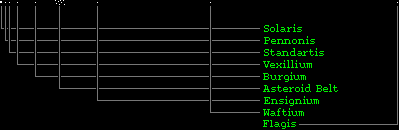
SolarisOur sun is a class F7 main-sequence star, burning with a bright white-yellow light. Its mass is 665,900 times that of Vexillium, its radius is 1,252,800 km. At an age of about 3 billion years, Solaris is halfway through its life as a main-sequence star. Solaris goes by many different names: In Lendia, it is called Alfaliray. | 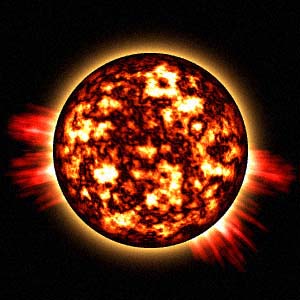 |
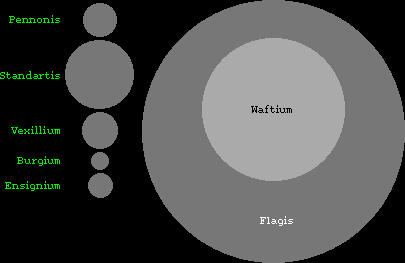
1. PennonisExtreme amounts of radiation from Solaris makes Pennonis an unwelcome, barren planet. Solar winds have blown away any atmosphere that Pennonis once might have held on to. Surface temperatures are estimated to be 800 °C during the day and -200 °C during the night. These extreme temperatures and high radioactive radiation from Solaris create conditions under which huge areas of the rocky surface becomes liquid or semi-liquid. This explains why there are relatively few craters on Pennonis, the rock melts, causing the craters to loose their form. Only the largest craters remain relatively unharmed by this process, and these are bent out of shape, resembling waves on water. As Lendian astronomers have previously calculated, Pennonis' orbit has a high (0.19) eccentricity. No satellites. | 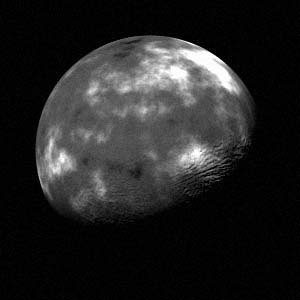 |
| Mean orbital radius(Million km) | Planetary year (Vexillium time) | Equatorial diameter(km) | Equatorial rotation period (Vexillium time) | Type | Known satellites |
| 31.4 | 36 days 13 hours | 11,300 | 46.7 days | Rock | 0 |
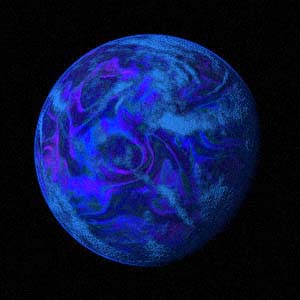
2. StandartisAlmost twice the diameter of Vexillium, Standartis has an even denser and thicker atmosphere than our home planet. Spectrograpy shows that it consists of carbondioxide (50%), nitrogen (25%), oxygen (15%), and water (10%). The blue areas in the image indicate water, but this is not the visual colour of the planet. Its closeness to Solaris and the massive green house effect inside its atmosphere, means that surface temperatures on Standartis are well above 500 degrees celsius, with little or no difference between day and night. Direct observation of the surface is impossible, but an ocean of water is likely to cover the planet's entire surface. Of course, this can't be concluded without landing a probe on Standartis. Violent, long lasting storms rage in the planet's upper atmosphere. |
|
| Mean orbital radius(Million km) | Planetary year (Vexillium time) | Equatorial diameter(km) | Equatorial rotation period (Vexillium time) | Type | Known satellites |
| 69.1 | 120 days 13 hours | 22,918 | 231.6 days | Rock | 3 |
Standartissatellites:
 S-II-A |  S-II-B |  S-II-C |
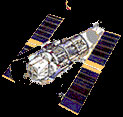
3. VexilliumOur home, planet Vexillium. Permanently veiled in clouds of varying thickness, nevertheless a planet spanning many different climates and a globe full of life. For ages uncounted, the dense atmosphere hid the treasures to be seen in our solar system, only recently exposed by ASA's orbital telescope. | 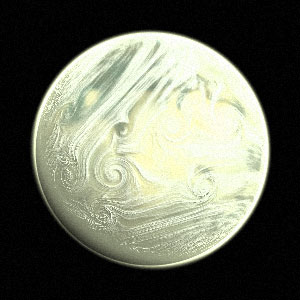 |
| Mean orbital radius (Million km) | Planetary year (Vexillium time) | Equatorial diameter (km) | Equatorial rotation period (Vexillium time) | Type | Known satellites |
| 145.1 | 365 days 6 hours | 12,287 | 23h 56m 4.1s | Rock | 1 |
S-III-A. LunaVexillium's companion is Luna, a moon about 1/3 of its parent celectial body's diameter. | 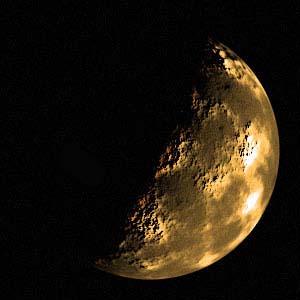 |
4. BurgiumBurgium's diameter is about half that of Vexillium. In theory Burgium could have an extremely thin atmosphere, but one has yet not been observed. The surface is littered with craters and other geological features, preserved through thousands of years without erotion. The colour-manipulated image to the right shows that the surface is made up from many different types of minerals, many most likely unique to Burgium. | 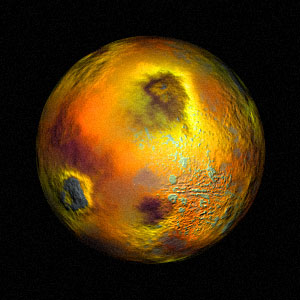 |
| Mean orbital radius (Million km) | Planetary year (Vexillium time) | Equatorial diameter (km) | Equatorial rotation period (Vexillium time) | Type | Known satellites |
| 326.6 | 3 years 138 days | 6,143 | 25h 51m 26.2s | Rock | 2 |
The Asteroid beltBetween the orbits of Burgium and Ensignium are some 7,000 asteroids larger than 1 km, and thousands of even smaller ones. The overall average orbital diameter of the asteroid belt is 630 million km (most of the asteroids' orbits are extremely eccentric). The first asteroid photographed by OT-1 is shown above, affectionately named "Leia" by ASA scientists. | 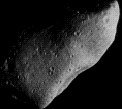 |
5. EnsigniumPerhaps the strangest planet in the system, Ensignium looks like a perfectly round and smooth ball with rougher parts on its northen hemisphere. This rock planet's high density and subsequent high gravity have gathered an atmosphere of almost pure methane, forming a thick layer of gas on the brink of becoming liquid floating on its surface. Ranges of tall mountains extend above this thick methane fog, without a question the tallest geological structures in the solar system. | 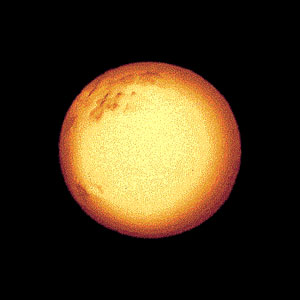 |
| Mean orbital radius (Million km) | Planetary year (Vexillium time) | Equatorial diameter (km) | Equatorial rotation period (Vexillium time) | Type | Known satellites |
| 942.9 | 16 years 208 days | 8,276 | 5.13 days | Rock | 5 |
Ensigniumsatellites:
 S-IV-C | 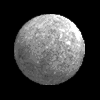 S-IV-E |
6. WaftiumUnlike the inner five planets, Waftium is a gas giant. The data gathered regarding this planet is not yet fully processed. More information will be published later. | 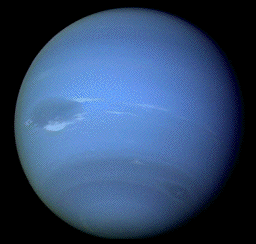 |
| Mean orbital radius (Million km) | Planetary year (Vexillium time) | Equatorial diameter (km) | Equatorial rotation period (Vexillium time) | Type | Known satellites |
| 2,075.5 | 54 years 22 days | 47,746 | 15h 32m | Gas giant | 26 |
7. FlagisThe second gas giant is the largest and outermost planet of our solar system. Although far from Solaris, temperatures on Flagis are probably equal to Vexillium's, thanks to thermal reactions in the planet's core. But, being a gas planet, Flagis has no surface like the inner rock planets, so no flag will ever be planted on the planet 4,000 million km from Solaris. | 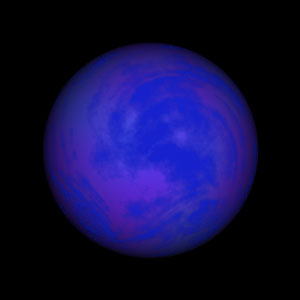 |
| Mean orbital radius (Million km) | Planetary year (Vexillium time) | Equatorial diameter (km) | Equatorial rotation period (Vexillium time) | Type | Known satellites |
| 3,941.5 | 141 years 212 days | 87,535 | 10h 5m | Gas giant | 20 |